Let them Go, Let them Grow
Discover why parenting must change as children grow. Learn how shifting from control to guidance helps children become mature, independent adults, and builds stronger family relationships based on respect and trust.

A common mistake parents make is failing to shift gears as time passes. What seems like perfect parenting when a child is young is rarely appropriate as they grow older. Confident parents are loving and supportive, encouraging their children to take steps toward maturity and independence.
When Love Becomes Limiting
Prem and Shalini are devoted parents to their son, Ranjit. He is the apple of their eye. They shower him with affection, constant support, and words of affirmation. They researched the best ways to enhance his development through creative, visual, and auditory stimulation. They attended every PTM, every sports match, every guitar performance. They listened patiently and guided every decision he made. They let him know repeatedly that he was the center of their world.
It sounds ideal — except that Ranjit is now 27 years old. He is a working professional and married to the love of his life. His parents’ excessive involvement now causes embarrassment and strain, yet he struggles to tell them without hurting their feelings.
Prem and Shalina’s mistake is common: they have not shifted their parenting style as their child matured.
Age-Appropriate Parenting: How Roles Change
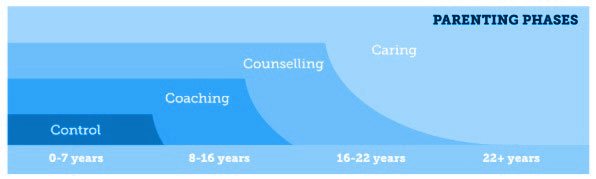
Ages 0–7: Parents in Control
During early childhood, children are fully dependent on parents for needs such as food, shelter, clothing, and safety. Loving authority in these years builds security and a healthy respect for boundaries.
Ages 8–16: Parents as Coaches
Children must gradually learn independence — commuting, making simple purchases, managing homework, preparing basic meals. When parents continue to do everything for them, teens struggle as young adults.
Ages 16–21: Parents as Counselors
In late adolescence, young people must make major life decisions — career paths, higher education, relationships, and moving away. Parents must guide, not control. Sequentially expanding their freedom helps them transition into responsible adults.
Unfortunately, many parents reverse this process — permissive in childhood, controlling in adulthood — resulting in resistance and rebellion.
When Parents Don’t Let Go
Many parents continue to treat grown children as if they are still kids, causing serious conflict and encouraging immaturity.
Take the example of Chetan. He spends all his earnings on modifying cars, maintaining multiple vehicles at a time. Even with a child ready for school and another on the way, he refuses to cut back expenses. His parents continue rescuing him financially, enabling irresponsibility. They blame the daughter-in-law for conflict rather than allowing the young couple to manage their marriage independently. Their interference only deepens the damage.
Healthy Love Means Letting Them Grow
One of the greatest goals of parenting is helping our children separate from us.
“The measure of a good parent is what we are willing not to do for our adult child.”
Holding on — controlling, advising, directing — is natural. Letting go feels unnatural. And yet, giving autonomy is the highest form of love. Preventing adult children from growing up is like preventing them from living fully.
We are horrified by extreme forms of parental control like honour killings. Yet, when we deny our adult children the right to think, feel, choose, and hope for themselves, we too are violating their autonomy — only in quieter ways.
Children Are Not Possessions
Stella shares, “I never wanted to be an engineer. My parents forced me.”
Sadly, her story isn’t rare. Many young people are pressured into careers to fulfill their parents’ dreams or to meet social expectations. Children are not tools for advancing status or achieving personal ambitions.
From Parent-Child to Adult-Adult Relationship
Confident parents support maturity and independence so their children grow into self-assured, responsible decision-makers. When that happens, a beautiful transformation occurs: parents and children become respectful friends.
Consider Asha, who says:
“Mom allows me to grow up. She doesn’t try to control me. That’s why I respect her ideas — and often ask for her advice.”
Influence remains — but it becomes healthy, valued, and mutual.
Leaving a Legacy That Builds Futures
Parents will always shape their children’s lives, regardless of age. The key is to ensure that influence is:
-
Caring
-
Positive
-
Life-giving
When we allow our children to become the adults they are meant to be, we give them the greatest gift — the freedom to live fully.
What's Your Reaction?