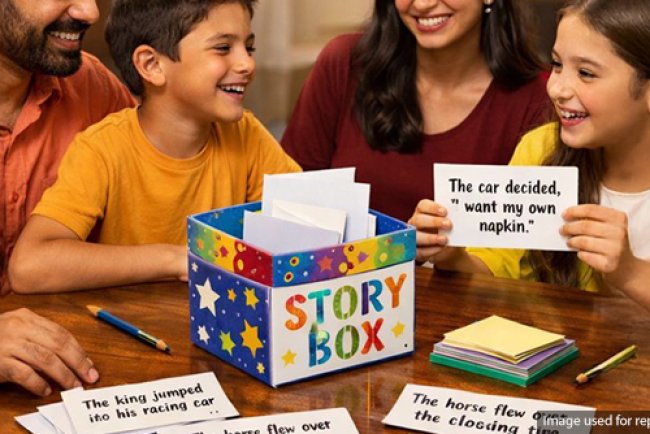
It’s Story Time!
Storytime can be more than entertainment. This guide shows parents how to transform everyday family time into a powerful tool for building values, communication, and creativity through interactive storytelling.

Guide your children not just to listen to stories, but to tell stories, stories that help them cultivate the values they need to lead in this world.
“Who loves stories?”
All the hands went up.
“Who hates stories?”
Not one hand rose, until, in the corner near the cupboard, a boy, big for his age, slowly raised his right hand.
I walked over and asked him why.
He looked me over with his little eyes and said,
“Well, I don’t hate all stories, just the ones told in a boring way… and maybe the ones that always point out my mistakes. Hmm… wait… also the ones where I have no role to play.”
I replied, “It sounds like you actually love good stories, and probably have a few of your own to share. Am I right?”
A reluctant grin spread across his face as he nodded.
From across the room someone called out, “Narain always has a story to share, Uncle!”
Soon others joined in, affirming this little big boy.
If you had seen my face then, you would have noticed a broad smile of joy.
This moment happened at a summer camp where I was invited to equip children with skills to perform stories.
Why Families Need Story-Time
One of the greatest needs of families today is quality family time, moments where parents and children come together for joyful interaction while building values.
And no, this cannot be achieved by sitting together in front of the “idiot box.”
Children today live in a world of vibrant colours, synchronised sounds, and powerful stories delivered through television, movies, and YouTube. While engaging, this constant stimulation has diluted their attention span, especially when it comes to listening.
For parents, ungluing children from these media magnets and teaching them to listen better requires intentional and engaging family time.
The answer I’ve discovered is Story-Time.
But when we read or tell stories, simple or complex, we are competing with powerful media. The solution is to involve children from the very beginning.
In other words, we must guide our children up the ladder of storytelling, from story listening to story performing.
Below are three practical steps to help you do just that.
Step 1: Interactive Story Listening
As you read or tell a story, allow children to actively interact with it.
Here’s how:
-
Let children choose the characters (you may retain control over the main character).
-
Choose the type of characters: animals, objects, people, fairies, monsters, superheroes, movie characters, or biblical characters.
-
Decide the setting, where the story unfolds.
-
Discuss and choose the moral beforehand so the value is clear.
-
Encourage interaction through:
-
Drawing and colouring characters
-
Sketching the setting
-
Playing music or creating background sounds
-
Acting out characters
-
Repeating key phrases or dialogue
-
Mix and match these ideas, and feel free to innovate your own storytelling style.
This approach brings the story alive in colour and sound, making it enjoyable for both children and parents.
Step 2: Shared Story Creation
In this stage, children actively contribute to the flow of the story.
-
Sit together in a circle.
-
One person becomes the Story Director, starting the story and guiding its direction, moral, and message.
-
Initially, prompt children with questions to help them contribute.
-
Gradually allow them 30 seconds each to add to the story.
-
Set boundaries beforehand so the story doesn’t wander too far off track.
-
Encourage acting, songs, sound effects, and non-verbal actions.
As the story moves around the circle, creativity grows.
As the Story Director, you can wrap up the story, offer applause, or reward participation with stars or stickers.
Tip:
Fix a time limit. If the story remains unfinished, continue it the next day, beginning with a recap.
Step 3: Child-Led Storytelling
In this final step, children take the lead.
Like adults, children collect life experiences. When they learn to connect these experiences with values, they gain wisdom that guides their journey.
So how do we help them discover these connections, without forcing lessons on them?
By helping them craft and perform their own stories.
The Story-Crafting Process
-
Listen attentively to your child’s experiences.
-
Capture the story through:
-
Quick sketches
-
Clarifying questions
-
Understanding emotions and voices
-
-
Build the story together with:
-
A clear beginning, middle, and end
-
A value woven naturally into the narrative
-
Story-crafting is a collaborative process. Children should understand:
-
Why a sequence works better
-
How voice, intonation, and gestures enhance performance
-
Why emotions matter in storytelling
Most importantly, have fun. Joyful collaboration teaches children the beauty of working with enthusiasm.
Once the story is ready:
-
Encourage your child to perform it
-
Allow them to change words, add gestures, and express emotions
-
Celebrate their effort, make storytelling a weekend tradition
Rediscover the Joy of Stories
Stories are the fabric of our lives. When children are trained in storytelling, they grow into:
-
Better listeners
-
Clear communicators
-
Collaborative thinkers
-
Confident participants
So this New Year, carve out intentional family time.
Rediscover the joy of delighting together with your children.
Happy Story-Time! ✨
What's Your Reaction?